
The short answer
Mix equal weights of whole wheat or rye flour and water in a jar, then throw out most of it and feed it fresh flour and water once a day. In about 5 to 14 days it will reliably double within a few hours of feeding, and that's your starter. Bake your first loaf the weekend after. You need flour, a jar and a kitchen scale, and that's about it.
Sourdough at a glance
Cost to start
$ under $50
First result
1-2 weeks
Per session
15 min
Learning curve
Moderate
| Cost to start | Under 50 USD: flour, a jar and a scale, if you already own an oven-safe pot with a lid |
|---|---|
| Ongoing cost | Low: mostly flour |
| Time to first result | 1 to 2 weeks (a lively starter takes 5 to 14 days, then your first loaf) |
| Time per session | 5 minutes a day to feed the starter. A loaf takes about 24 hours start to finish, but only 30 to 45 minutes of that is hands-on |
| Space needed | A drawer |
| Indoor or outdoor | Indoor |
| Solo or social | Solo |
| Physical intensity | Low |
| Learning curve | Moderate: the starter is easy, but it takes a handful of loaves to get consistently good bread |
| Good if you like | science experiments you can eat, slow weekend routines, feeding people |
| Good for ages | Any age (kids love naming the starter; an adult handles the hot pot) |
| Noise and mess | Some mess: flour gets everywhere and dough is sticky |
| Best season | Year-round (starters are slower in a cold winter kitchen, so find a warm spot) |
Learning how to make a sourdough starter is the whole trick to sourdough. It takes flour, water, a jar and about five minutes a day for a week or two. This guide takes you from an empty jar to your first loaf, with what it costs, how much time it really takes, and a clear test for when your starter is ready.
What is sourdough? (And why people love it)
Sourdough is bread raised by wild yeast and bacteria instead of a packet of commercial yeast. Those microbes live on flour and in your kitchen already. A “starter” is just a paste of flour and water where you’ve encouraged them to set up home. Feed it regularly and it bubbles, rises and smells pleasantly tangy. Add a spoonful of it to a dough and it does the job of yeast, slowly, which is where sourdough’s flavor, chew and crackly crust come from.
A typical bake looks like this: you feed the starter in the morning, mix a dough a few hours later, give it a few gentle folds over the afternoon, shape it in the evening and let it rest in the fridge overnight. You bake it the next morning. That sounds like a lot, but most of that time you’re not doing anything. The dough is.
People get hooked because it’s equal parts cooking and chemistry experiment. Every loaf teaches you something, the results are genuinely better than most supermarket bread, and there’s something deeply satisfying about bread made from nothing but flour, water and salt. Plus, you now have a pet that lives in a jar.
Is sourdough right for you?
You’ll probably love it if:
- You enjoy routines, like feeding a starter with your morning coffee.
- You like learning by trial and error, and you can laugh at a flat loaf (it still makes great toast).
- You’re home at least part of most days, or you’re happy to bake on weekends.
- You want a cheap hobby that ends with something everyone wants to eat.
Maybe skip it (or try something else) if:
- You want results tonight. Sourdough runs on days, not hours. A quick yeasted loaf or home espresso might scratch the itch faster.
- You can’t eat gluten. Gluten-free sourdough exists, but it’s a different (and harder) skill set.
- You travel constantly. A starter can live in the fridge for a week or two between feeds, but it does need occasional attention.
Sourdough or regular yeast bread?
Regular yeast bread is easier and faster: a basic loaf can go from bowl to oven in about three hours, and it’s very forgiving. Sourdough takes longer and has more variables, but it tastes better, keeps fresh longer and costs nothing in yeast once your starter is going. If you’ve never baked bread at all, a couple of easy yeasted loaves first will teach you how dough should feel. If you’re excited about sourdough specifically, though, you can start straight here. Plenty of people do.
Is it better to make or buy a sourdough starter?
Either works. Making one costs almost nothing and teaches you how a starter behaves, but it takes a week or two and sometimes a restart. Buying a dried or fresh starter is a little more reliable, and it’s a nice gift. Most bakers say the starter you keep feeding matters more than where it came from. We compare the options in our guide to the best sourdough starter kits.
How much does sourdough cost to start?
Try it
about 20–35 USD
A bag of whole wheat or rye flour, a bag of bread flour, a clean glass jar and a digital kitchen scale. Bake in any oven-safe pot with a lid.
Proper starter
about 80–120 USD
A cast iron Dutch oven, a proofing basket (banneton) set, a bench scraper and a dough whisk.
Upgrade later
150+ USD
A combo cooker or bread oven, a proofing box for cold kitchens, and a grain mill if you get really deep into flour.
Don't buy yet: a proofing box, a grain mill, or a fancy "heirloom" starter. You can make a perfectly good starter for the price of a bag of flour. A starter kit is a nice shortcut if you want the jar, scale and basket in one box (or you're buying a gift), but you don't need one.
Sourdough safety: mold, hooch and hot pots
Sourdough is a very safe hobby, but a starter is a live culture and a bread pot gets extremely hot. These are the things that matter.
- Hot pot: a Dutch oven preheated to 450–475°F will burn you through a thin towel. Use proper oven mitts, and lower the dough in on a sheet of parchment.
- Hooch is fine: grey liquid on top (“hooch”) is just a hungry starter, and it’s harmless. Pour it off and feed.
- Mold means start over: fuzzy spots, or pink or orange streaks, mean mold. Don’t scrape it off. Throw it out, wash the jar well and start again.
- Selling bread is different from baking it: giving loaves to friends is one thing. Selling them falls under food rules.
How to make a sourdough starter: your first week
This is the starter week. It takes about 5 minutes a day. Weigh everything in grams; cups are too inconsistent for this. For the full day-by-day schedule, troubleshooting and storage, see our complete guide on how to make a sourdough starter.
- Day 1, mix it: in a clean jar, stir together 50 g whole wheat or rye flour and 50 g lukewarm water until no dry flour remains. Put the lid on loosely, put a rubber band around the jar at the level of the paste, and leave it somewhere warm, ideally 75–80°F.
- Day 2, wait: you may see a few bubbles, or nothing. Both are normal. Leave it alone.
- Days 3 to 4, start feeding: once a day, throw out (or save) all but about 50 g of the starter, then stir in 50 g flour and 50 g water. You can switch to half whole wheat and half bread flour. Expect a dramatic rise around day 2 or 3, followed by a quiet spell. That first burst usually comes from bacteria that die off as the jar gets more acidic, not from the yeast you want. Don’t panic, and don’t quit.
- Days 5 to 7, watch for the double: keep feeding once a day, or twice if it’s warm and very active. You’re looking for a starter that reliably doubles in size (check your rubber band) within 4 to 8 hours of a feed, smells pleasantly sour or yogurty, and is full of bubbles. In a cool kitchen this can take up to two weeks.
- Ready? Bake. Once it doubles predictably for two or three days in a row, it’s ready for bread. Feed it the night before baking so it’s at its peak when you mix your dough.
How do you know when sourdough starter is ready?
A starter is ready to raise bread when it passes three checks, two or three days in a row:
- It doubles. It at least doubles in size within about 4 to 8 hours of a feed. The rubber band makes this easy to see.
- It’s bubbly all the way through. Look through the side of the jar: you want bubbles of all sizes, not just a few on top. The surface should be domed or just starting to flatten.
- It smells right. Pleasantly sour, like yogurt or mild vinegar. Sharp nail-polish smells mean it’s hungry, so feed it more often.
You’ll also hear about the “float test”: drop a spoonful into water and see if it floats. It can help, but it isn’t foolproof, especially with whole grain starters. Trust the rise more than the float.
How to make your first loaf with a homemade starter
Your first project: a simple country loaf. 500 g bread flour, 350 g water, 100 g active starter, 10 g salt.
- Mix: stir the flour, water and starter together until there’s no dry flour, then rest it 30 minutes.
- Add salt: sprinkle on the salt and squeeze it into the dough with wet hands.
- Stretch and fold: over the next two hours, do 3 or 4 sets of “stretch and folds”. Grab one side of the dough, stretch it up, fold it over, turn the bowl, and repeat four times.
- Let it rise: leave it until it’s grown by about half and looks puffy and jiggly. That’s usually 4 to 8 hours total at room temperature.
- Shape and chill: shape it into a tight ball, put it seam-side up in a towel-lined bowl dusted with flour, cover it and refrigerate overnight.
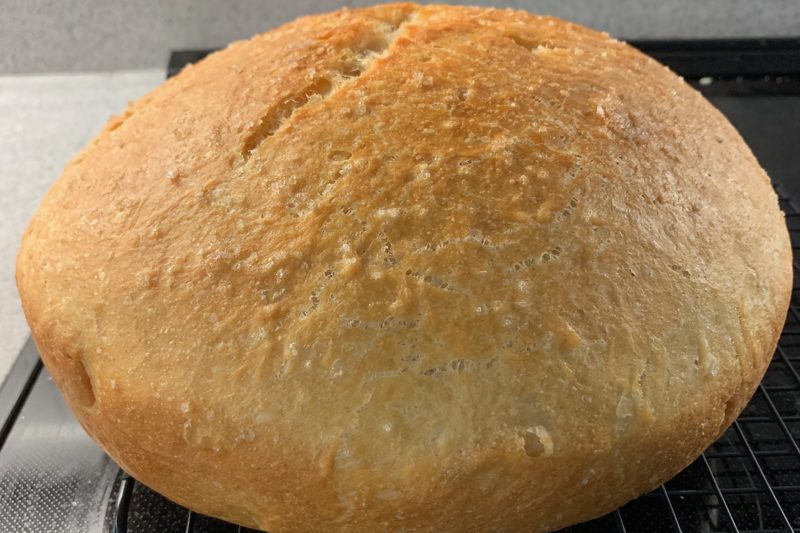
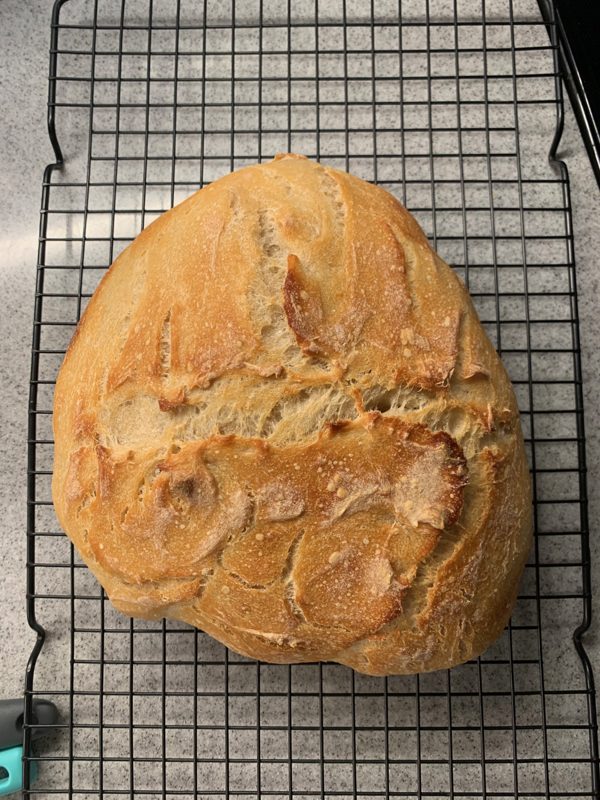
- Bake: in the morning, preheat your pot at 475°F for 45 minutes. Tip the dough onto parchment, slash the top with a sharp knife or razor, and bake 20 minutes with the lid on, then 20 to 25 minutes with it off until deep brown.
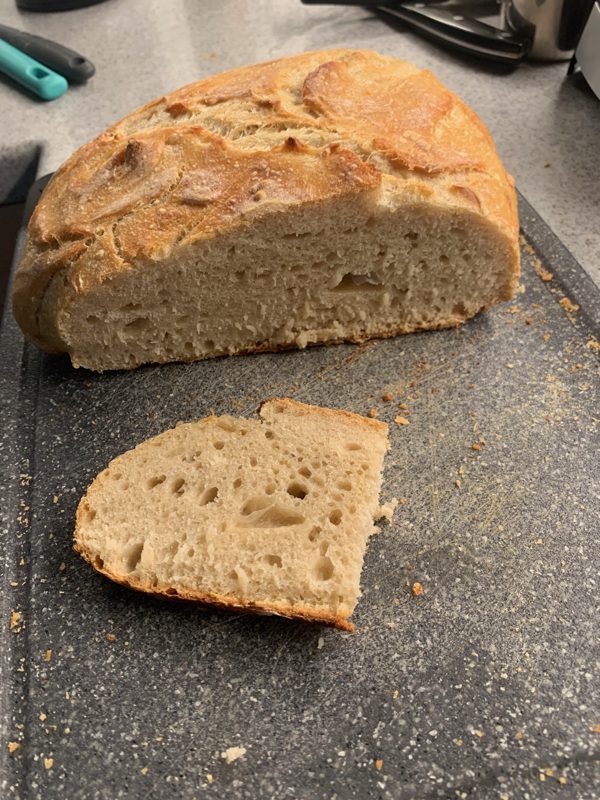
- Wait: let it cool for at least an hour before cutting. The inside is still cooking.
Is sourdough hard to learn? Your first three months
The starter is easy. It just takes patience. Good bread takes a handful of attempts, mostly to learn how the dough should look when it’s ready. Expect your fourth loaf to be much better than your first. Here’s what normal progress looks like for a home baker, not a professional.
- How to practice: bake once a week. Change one thing at a time (more water, longer rise, a different flour) and jot a note on what happened. A weekly bake with notes teaches you more than three random bakes in a weekend.
- By the end of month 1: you can keep a starter alive without thinking about it, and you’ve baked three or four loaves. At least one was flat or dense, and at least one made you unreasonably proud.
- By month 3: you can read your dough. You know what “ready to shape” looks and feels like, your loaves are consistently good, and you’ve branched out into sandwich loaves, focaccia, pizza dough or discard pancakes.
- The wall most people hit: the flat, dense loaf that won’t improve. It’s almost always fermentation: either the starter wasn’t at its peak, or the dough rose too little or too long. Fix it by baking on a schedule, using a clear straight-sided container for the rise so you can see how much it’s grown, and watching the dough rather than the clock.
How to keep a sourdough starter in the fridge
Once your starter is strong, you don’t have to feed it every day. Most home bakers keep it in the fridge between bakes.
- Weekly feed: once a week, discard all but a small amount, feed it, let it sit out an hour or two, then put it back in the fridge.
- Before you bake: take it out a day or so ahead and give it one or two feeds at room temperature, so it’s doubling reliably again.
- Neglected it? A starter that’s been forgotten for a few weeks usually recovers. Pour off the hooch, discard most of it, and feed it twice a day somewhere warm for a couple of days.
Common beginner mistakes
- Giving up during the quiet spell. That day-4 slump after the early burst of bubbles is normal. Keep feeding, and the real yeast will take over.
- Measuring with cups. A cup of flour can vary by 30 grams or more depending on how you scoop it. A cheap scale fixes most “my dough is soup” problems.
- Using the starter too early or too late. Starter is strongest when it’s at or just past its peak rise. If it has collapsed back down and gone runny, feed it and wait.
- A starter that’s too cold. At 65°F, everything takes far longer. Try the oven with only the light on, the top of the fridge, or near (not on) a radiator.
- Cutting the loaf hot. It’s tempting, but the crumb finishes setting as it cools. Cut early and it turns gummy.
Sourdough rules of thumb and words you’ll hear
- Baker’s percentages: every ingredient is written as a percentage of the flour weight. “70% hydration” means 70 g of water for every 100 g of flour. That’s why our recipe uses 350 g water for 500 g flour. Lower hydration is easier for beginners to handle.
- 1:1:1 feeding: one part starter, one part flour, one part water, by weight. It’s the standard feed. Go 1:2:2 or 1:5:5 to slow it down in a warm kitchen.
- Discard: the starter you remove before feeding. You discard so the jar doesn’t grow forever and the flour-to-microbe balance stays healthy. It’s great in pancakes, crackers and waffles.
- Hooch: the grey liquid that forms on a hungry starter. Pour it off (or stir it in for a tangier bread) and feed.
- Levain: a small batch of starter built specifically for one bake. Many recipes say “levain” where you can just read “active starter”.
- Bulk fermentation: the first long rise after mixing. It’s the stage that matters most, and the one beginners most often cut short.
The best free resources for learning sourdough
Sourdough has a huge, generous community. These are the places beginners consistently get the most help.
- Videos: Bake with Jack, for calm explanations of why each step matters. Brian Lagerstrom, for clear, no-nonsense home bakes. King Arthur Baking’s YouTube channel, for technique close-ups like shaping.
- Community: r/Sourdough (read the pinned FAQ before posting; people there will diagnose your crumb photo in minutes) and r/Breadit for bread in general.
- Free recipes and guides: The Perfect Loaf (Maurizio Leo’s site, with deep beginner guides) and King Arthur Baking’s sourdough guides. King Arthur also runs a free Baker’s Hotline you can call or chat with.
- Tools: no app needed. Baker’s percentages are simple multiplication, and any free online baker’s percentage calculator will scale a recipe up or down.
- A book: Flour Water Salt Yeast by Ken Forkish is the book home bakers recommend most for learning artisan bread at home.
- In person: ask a local bakery for a spoonful of their starter (many will happily share), or look for a bread class at a cooking school, community college or kitchen store.
Buying for a baker instead? See our gifts for bakers. And if you like looking after a live culture, kombucha runs on the same feed-it, watch-it, taste-it rhythm.
Where to go next
Ready to go deeper?
We get you started. These are the specialist sites and communities we'd send a friend to next.
- The Perfect Loaf ↗the best place online to go from good bread to great bread, with detailed schedules and troubleshooting
- King Arthur Baking ↗reliable tested recipes, flour know-how, and a real human to ask on the Baker's Hotline
- Breadtopia ↗recipes and an active forum for whole grain and artisan bakers
If you like sourdough, try...


More on sourdough
Sourdough FAQ
How often should I discard sourdough starter?
Every time you feed it. On the counter that's usually once a day. In the fridge, discard and feed once a week, then give it a feed or two at room temperature before you bake.
Can I use tap water for sourdough?
Usually, yes. If your starter seems sluggish and your water is heavily treated, try filtered water. Leaving tap water out overnight lets chlorine escape, but it won't remove chloramine, which many cities use instead.
How do I make my sourdough starter stronger?
Keep it warm (75 to 80°F), feed it on a consistent schedule, and add a little whole wheat or rye flour to each feed. A couple of days of twice-daily feeds at room temperature will revive a starter that's been neglected in the fridge.
How do you wake up a dehydrated sourdough starter?
Mix the dried flakes with water to soften them, stir in flour, then feed it daily just like a new starter until it doubles reliably. It usually takes several days to a week. Follow the instructions that came with it, since they vary.
Can I use discard straight from the fridge?
Yes, for discard recipes like pancakes, crackers and waffles, which get their lift from baking soda or powder anyway. Don't use unfed fridge starter to raise a loaf of bread. It won't have the strength.
How much does it cost to get into sourdough?
Around 20 to 35 USD if you already own an oven-safe pot with a lid: flour, a jar and a kitchen scale. A full setup with a Dutch oven and proofing basket runs closer to 100 USD.
Is it too late to start sourdough at 40, 60 or 80?
Not at all. Sourdough is gentle on the body and rewards patience over speed. The only physical part is lifting a hot pot, and you can bake in a lighter pot or on a baking stone instead.
Can you make money from sourdough?
Some people sell loaves at farmers markets or from home under their state's cottage food laws. This isn't legal advice: those rules vary a lot by state and change often, so check your state's official rules before you sell.